


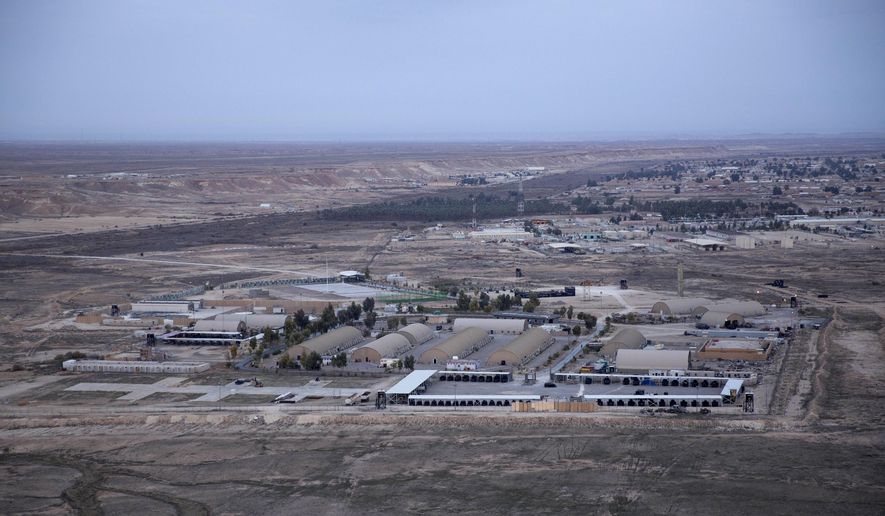

Two U.S. servicemen were injured in the latest rocket attack on American forces stationed in Iraq, adding new fuel to a clash between the U.S. military and Iraqi Shiite militia groups with strong ties to Iran.
A second attack Wednesday on U.S. and U.S.-allied Syrian forces operating in eastern Syria was foiled, officials said.
An investigation was already underway to find out who was behind an attack early Wednesday that sent more than a dozen rockets onto a base in western Iraq that hosts U.S. and coalition forces involved in the international campaign against the Islamic State.
Pentagon officials said two U.S. service members sustained minor injuries in the barrage and were treated for concussions and abrasions.
At least 14 rockets were fired at Iraq’s Ain al-Asad Air Base. Rockets landed both on the base and in the general area, reportedly damaging homes and a mosque in the area.
Powerful Iraqi Shiite militia groups, with strong support from Iran and only tenuous under the control of Baghdad, have led the push to drive the remaining contingent of U.S. and allied troops from the country. The U.S. mission remains in Iraq nearly two decades after the ouster of Saddam Hussein to prevent a resurgence of the Sunni terror group Islamic State.
The Iraqi central government, desperate to avoid being dragged into a shooting war between Washington and Tehran, condemned Wednesday’s attacks.
“Once again, the enemies of Iraq are intrusive and targeting the country’s security, sovereignty and the safety of our citizens,” Iraqi Ministry of Defense spokesperson Yehia Rasool tweeted.
Iraqi military sources told Reuters that a rocket launcher that had been attached to the back of a truck was used in the attack. It was later found in a nearby farmer’s field where it had been set ablaze.
Col. Wayne Marotto, a spokesman for the U.S. mission in Iraq, said the rocket attack “undermines the authority of Iraqi institutions, the rule of law and Iraqi national sovereignty.”
“Each attack against the coalition endangers the lives of [Iraqi security forces] and peshmerga forces,” Col. Marotto said in a Twitter post. The peshmerga are the military forces of Iraq’s semi-autonomous Kurdish region.
The rocket barrage came less than two weeks after President Biden ordered U.S. airstrikes on a pair of Iran-backed Iraqi militia groups operating in both Syria and Iraq, reportedly killing four militants. Pentagon officials said the Shiite groups, Kata’ib Hezbollah and Kata’ib Sayyid al-Shuhada, were behind at least five drone attacks on U.S. forces since April and with a number of other rocket barrages.
Dozens of American service members suffered brain injuries in January 2020 during a rocket attack on the al-Asad airbase. The assault was in retaliation for an earlier U.S. airstrike that killed Gen. Qassem Soleimani, a senior Iranian military leader, and a top commander of Iraqi militia forces who was meeting with him at Baghdad’s airport.
Tamar Badawi, a security analyst based in Turkey, said an insurgent group calling itself “Tha’ar al-Muhandis,” has claimed responsibility for Wednesday’s attack. He said the group has been posting messages about it on the Telegram social media platform, claiming 30 rockets were fired with the targets being struck “with high precision.”
“We reiterate to the brute (sic) occupation that we will force you to withdraw from our lands undefeated,” Mr. Badawi said they wrote.
In a Twitter post, Mr. Badawi said Tha’ar al-Muhandis first appeared in May 2020 and was the fourth or fifth insurgent militia to sprung up since Iraqi paramilitary groups began outsourcing operations to new groups.
“The group is famous for claiming in May 2020 the targeting of a U.S. Chinook [helicopter] with two ground-to-air missiles in Baghdad’s southern belt,” Mr. Badawi tweeted.
• Ben Wolfgang contributed to this report.
• Mike Glenn can be reached at mglenn@washingtontimes.com.

Please read our comment policy before commenting.