


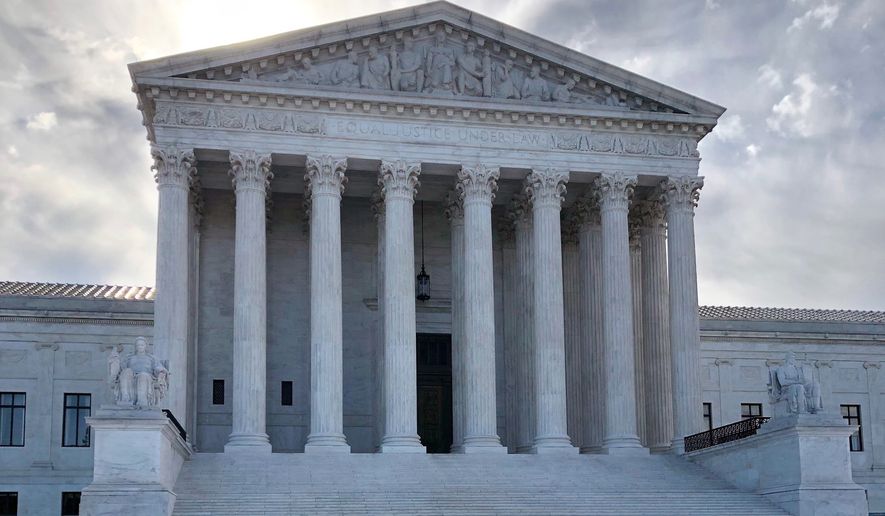

The Supreme Court ruled Monday that victims and families of those killed in terrorist attacks at U.S. embassies in 1998 can recover more money in damages from Sudan, potentially giving Sept. 11, 2001, families and other terror victims a better chance to punish foreign countries for their pain and suffering.
The lawsuit was brought by victims and families of people killed by al Qaeda truck bombings outside U.S. embassies in Kenya and Tanzania, which resulted in more than 200 deaths and thousands of injuries.
The Republic of Sudan faced a state-sponsored terrorism lawsuit brought by about 500 foreign and U.S. victims that claimed Sudan assisted al Qaeda in the attacks by providing the terrorists with passports they used to cross borders. The lawsuit was filed in federal court under a terrorism exception to the Foreign Sovereign Immunities Act.
A lower court awarded the families more than $10 billion in various damages, but a federal appeals court ruled punitive damages — those awarded against a defendant as punishment — weren’t permitted since Congress updated its law after the original lawsuit had been filed. As a result, the recovery amount was lowered by more than $4 billion.
The high court’s unanimous 12-page opinion written by Justice Neil M. Gorsuch reinstated the $4.3 billion in punitive damages.
Justice Brett M. Kavanaugh did not take part in the ruling.
“Because foreign sovereign immunity is a gesture of grace and comity … it is also something that may be withdrawn retroactively without the same risk to due process and equal protection principles that other forms of backward-looking legislation can pose,” Justice Gorsuch wrote.
The 1998 attack was one of the first to draw attention to al Qaeda and resulted in the FBI placing Osama bin Laden on its 10 Most Wanted list.
Ilya Shapiro, the publisher of the Cato Institute’s Supreme Court Review, said the ruling could “potentially” assist families of the victims of the Sept. 11 terrorist attacks in their attempt to recover from Saudi Arabia, where 15 of the 19 al Qaeda hijackers were citizens.
Historically, there has been a high bar for recovering damages from foreign countries, which generally have been afforded immunity. Congress did create exceptions within the Foreign Sovereign Immunities Act such as “commercial activity” and “state-sponsored terrorism.”
Saudi Arabia previously invoked the Foreign Sovereign Immunities Act in lawsuits brought by Sept. 11 families. In response, Congress passed the Justice Against Sponsors of Terrorism Act in 2016, amending the legislation to permit lawsuits against Saudi Arabia in the U.S. court system.
Most recently, some members of Congress have moved to allow an exception for suing China to recover economic damages from the COVID-19 pandemic that originated in Wuhan.
• Alex Swoyer can be reached at aswoyer@washingtontimes.com.

Please read our comment policy before commenting.