


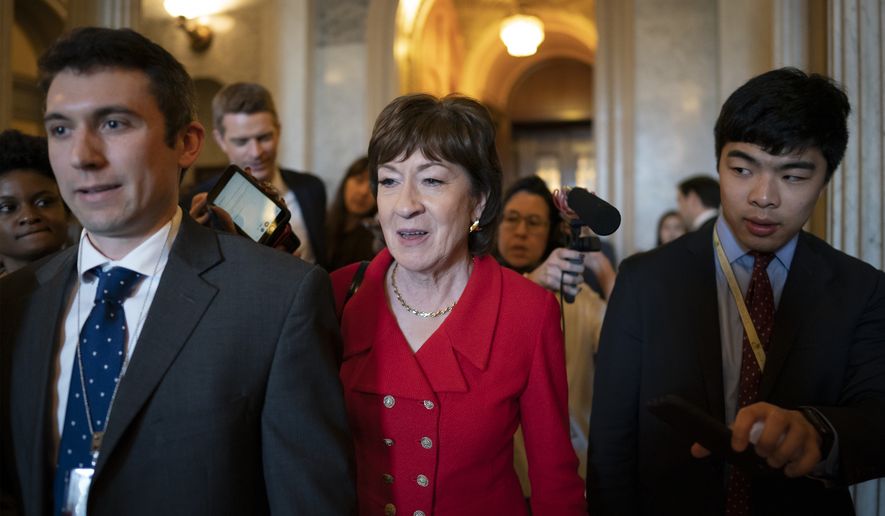

Sen. Susan M. Collins said Tuesday she will vote to acquit President Trump on both articles of impeachment, putting pressure on Sen. Mitt Romney as Republicans look to cement a major statement of unity in Wednesday’s vote.
The Utah Republican has been one of the more vocal critics of the president and is the last Republican whose vote is uncertain. He has not tipped his hand, though last week he did support a failed bid to call witnesses and extend the trial.
Ms. Collins also supported that effort, but she said Tuesday that the case against Mr. Trump doesn’t rise to the level of impeachable offenses.
“The high bar for removal from office is, perhaps, even higher when the impeachment is for a difficult-to-define non-criminal act,” the Maine Republican said. “I will vote to acquit.”
The House has brought two articles of impeachment: One for abuse of power, stemming from July 25 phone call when the president asked the Ukrainian president to investigate political rival former Vice President Joseph R. Biden, and the other for obstruction of Congress.
Ms. Collins said Tuesday that trying to rope Ukraine into American politics was a mistake on the president’s part.
“It was wrong for him to ask a foreign country to investigate a political rival,” she said.
But she said Democrats failed to meet their burden to prove abuse of power, and she said they failed to compel testimony and document production during the impeachment inquiry, so the obstruction of Congress charge was not sustained.
Another Republican who was on the fence, Sen. Lisa Murkowski of Alaska, announced Monday she wouldn’t vote to convict the president.
Democrats had hoped a handful of Republicans might join them in their uphill bid to oust Mr. Trump before the election.
Republicans, meanwhile, are hoping several Democrats defect to join them in opposing the articles of impeachment.
Sen. Joe Manchin III of West Virginia, who is considered the most likely Democrat to side with Mr. Trump, said he has not decided how he will vote. He did not take to the chamber floor Tuesday with an update.
It would take a vote by 67 senators to remove Mr. Trump from office, and the current math suggests there are at most 48 ready to do so.
Mr. Trump was impeached on both articles on Dec. 18. No Republican voted for the articles, and several Democrats joined them in opposition. It was the first time impeachment has been by partisan vote.
Senate Majority Leader Mitch McConnell, Kentucky Republican, called on his colleagues Tuesday to end the “nonsense impeachment.”
He said the only high crime and misdemeanor committed by Mr. Trump was his defeat of Hillary Clinton in 2016.
“That is the original sin of this presidency — that he won and they lost,” Mr. McConnell said.
He argued House Democrats were the ones abusing power, forgoing House Speaker Nancy Pelosi’s vow to pursue impeachment only if it were bipartisan.
“The impeachment power exists for a reason. It is no nullity, but invoking it on a partisan whim to settle three-year-old political scores … it insults the framers’ design,” he said.
Senate Minority Leader Charles E. Schumer, New York Democrat, said Mr. McConnell was repeating Republican talking points and said the Senate trial was unfair without hearing from witnesses and subpoenaing documents.
Mr. Trump’s lawyers had asked in their closing arguments Monday for senators of both parties to vote to acquit the president to end an era of impeachment.
They also suggested voters should punish Democrats for attempting to impeach the president in the first place.
• Alex Swoyer can be reached at aswoyer@washingtontimes.com.

Please read our comment policy before commenting.