



OPINION:
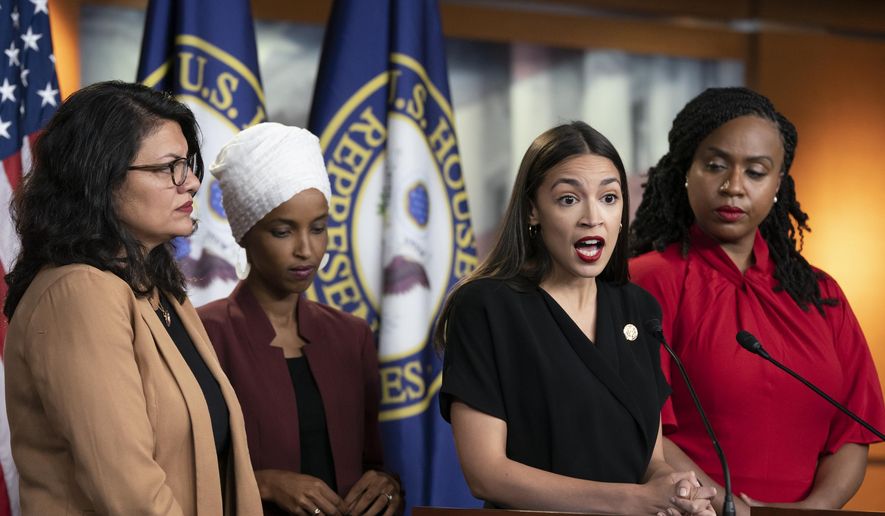
In attacking “the Squad,” President Trump again undercut sound strategy with unsound tactics. Contrasting himself with Congress in general — and House Democrats in particular — is strategically astute. However, focusing on these four first-term women is the wrong way to advance it. Instead of shrinking his target, he needs to expand it to the Democratic Party and their eventual nominee.
It is hardly the first time Mr. Trump’s instincts have been right but his outbursts have been wrong. On July 14, he tweeted about the “Progressive Democratic Congresswomen”: “Why don’t they go back and help fix the totally broken and crime infested places from which they came. [sic]”
Known as “the Squad,” all four are women, freshmen and minorities. His statement’s crucial inaccuracy, gave easy opening to his opponents: Only one came from abroad and all are U.S. citizens. Immediately labeling the attack “racist,” Democrats rushed to the Squad’s defense.
Mr. Trump’s remarks were a godsend to the House Democratic leadership, who were themselves embroiled in a fight with the Squad, and had “racist” aimed at them. Their fight had erupted over a border crisis spending bill, which had passed the House — but split the party — just before July 4. During that debate, the Squad and others on the party’s left had targeted moderate Democrats with immoderate accusations. That eruption still smoldered when Mr. Trump blundered.
To understand Mr. Trump’s transformative effect, look at two votes. On the June 27th border funding vote, Democrats split: 129 in favor and 95 opposed. That split between moderates and the left festered for two weeks … until Mr. Trump’s 7/14 tweet. On July 17, House Democrat leadership moved to condemn Mr. Trump’s remarks: All 235 Democrats voting in support. The Democrats’ split disappeared, replaced by unity against Mr. Trump.
Mr. Trump’s strategy to position himself against the Democratic House was right, just his tactics to pursue it were wrong.
Attacking Congress is very advantageous to Mr. Trump. On July 22, Real Clear Politics averaged Mr. Trump’s national job approval: 45 percent; for Congress it was less than half his — 19.2 percent. Such an advantage is definitely worth exploiting.
Historically, this has proved fruitful, too. Most famously, Harry Truman did so running against what he dubbed a “Do Nothing” Republican Congress. Despite having initially questionable re-election prospects, he won relatively comfortably — and flipped Congress to Democratic control. Bill Clinton won re-election in 1996 doing the same.
Combined with this general unpopularity are individual Democrats’ particular instances. Mr. Trump has already seized on some’s espoused socialism. The Squad presents similarly inviting targets. Firebrands to their own leadership, they constantly produce hot-takes and headlines.
Mr. Trump is strategically correct to look to exploit these opportunities. However, focusing on the Squad narrows the focus when his greater advantage would come from expanding it to their broader party — especially their eventual 2020 nominee.
Instead of interjecting himself into the Squad, Mr. Trump should be seeking to drag the rest of the Democrats into it. This is exactly what the House Democratic leadership sought to avoid before Mr. Trump temporarily solved their problem for them.
Again, a House vote reveals the House Democratic leadership’s problem. On the same day they voted to condemn Mr. Trump’s tweets on the Squad, leadership had to beat back an impeachment motion against Mr. Trump. The intra-party split resurfaced: 137 opposing impeachment and 95 supporting.
The Democratic split between moderates and left is real. Mr. Trump does not need to exacerbate it — Democrats will do that for him — he needs to exploit it.
The best way to do so is not by injecting himself into their fight, but forcing Democratic leaders and moderates to take a stand on their left’s actions — not his.
Forcing Democrats to take a position on their left offers far more reward and much less risk for Mr. Trump. A consummate entrepreneur, Mr. Trump should see the advantage in that in politics as well as business. He simply needs to keep putting that ball back over the net and making them scramble to it.
Instead of personifying the left through the Squad, he should be “party-fying” Democrats through the Squad. Doing so presents them an impossible choice: Alienating their left or their moderates. Difficult for Democratic leaders now, it will be impossible for Democrats’ nominee next year.
• J.T. Young served in the Office of Management and Budget and at the Treasury Department.

Please read our comment policy before commenting.