



OPINION:
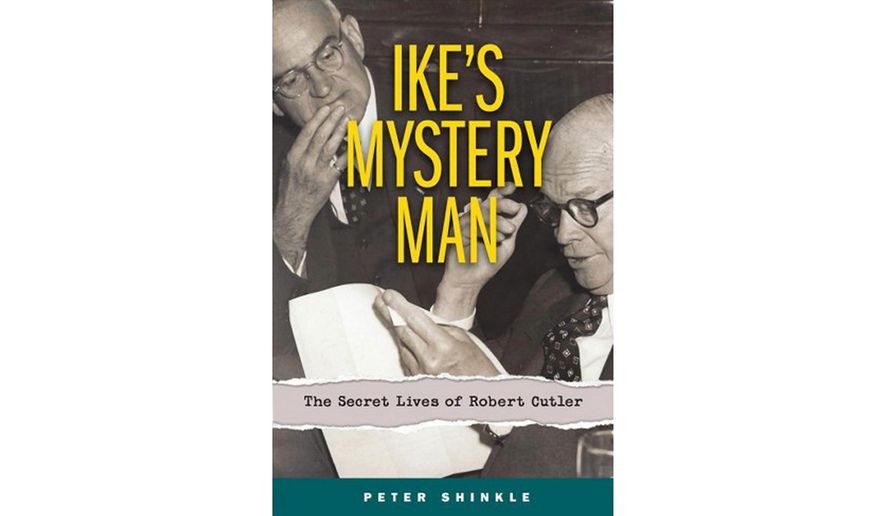
IKE’S MYSTERY MAN: THE SECRET LIVES OF ROBERT CUTLER
By Peter Shinkle
Steerforth Press $29.95 401 pages
For Washington homosexuals, the early 1950s were rugged times for federal employees, especially those in the State Department.
Sen. Joseph McCarthy’s campaign to “ferret out communists who endanger national security” had shifted to supposed gays in the diplomatic corps. The vice squad chief of the Metropolitan Police Department estimated that 300 to 400 State employees were homosexual (an off-the cuff guess he later retracted).
Although incoming President Dwight Eisenhower detested McCarthy, he responded to the furor by ordering a screen of employees to search for communist or criminal leanings or “sexual perversion.” The rule resulted in 843 federal employees being fired and another 2,283 resigning.
The security fears had some basis: That closet homosexuals could be blackmailed into spying.
By remarkable irony, Eisenhower’s order was written by Robert Cutler, his national security adviser, the top foreign policy post in the White House. (Foreign policy luminaries such as Henry Kissinger and McGeorge Bundy held the post in subsequent years.)
Cutler had a deep secret: Under the new rule — one that he wrote — he should have been fired. Since boyhood, he had been a hidden homosexual. His secret was known to Harvard classmates (where he was picked for the exclusive Porcellian Club) but to few others.
Known to friends and associates as “Bobby,” he had a stellar career in Boston, first as a lawyer, then as a bank president. During World War II he ran a Pentagon program to recruit new officers and, although a civilian, earned the protocol rank of “general.”
Gen. George C. Marshall called him back to government service in 1948 to help obtain legislation enhancing the Defense secretary’s control of the services and creating the position of chairman of the Joint Chiefs of Staff.
After working in the 1952 Eisenhower campaign, Cutler was appointed to run the National Security Council (NSC) and the Psychological Strategy Board. In due course, his expertise — both as a thinker and an administrator — earned him plaudits as a guide of foreign policy. As one colleague remarked, “Ike rages, Bobby just proceeds quietly with the business at hand.”
All the while, Cutler led the second and most serious life as a homosexual. His story is revealed publicly for the first time in Peter Shinkle’s remarkable and highly readable account, “Ike’s Mystery Man.”
A former St. Louis journalist, Mr. Shinkle is a great-nephew of Cutler. An aunt told him of Cutler’s hidden life. An archivist at the Eisenhower Library gave him Cutler’s six-volume diary — more than 163,000 words on 725 pages — in which Cutler “poured out his feelings” for Skip Koons, a young Navy officer and former CIA operative on the NSC staff. He also obtained hundreds of letters the two had exchanged over the years.
Given the hysteria over “gays in government,” how did Cutler — and Koons — slip through FBI Director J. Edgar Hoover’s security net? According to Mr. Shinkle’s research, “there is no evidence that the FBI ever probed Skip’s background and completed a background report.”
(Investigators, indeed, might have been misled had they discovered Koons’ sexual relations with a Washington woman before he joined the NSC. Koons suggested the relationship was “merely intended to hide his homosexuality.”)
And Koons had another male relationship as well: With a man named Steve Benedict, who had been appointed White House chief of security. On appointment, Benedict was Hoover’s guest at an Army and Navy Club cocktail party.
Cutler helped guide Eisenhower through uncountable foreign policy tests — ranging from the overthrow of governments in Guatemala and Iran to confrontations with Moscow over nuclear warfare issues.
As did Eisenhower, he saw the value of foreign allies because American forward bases were in allied territories.
Unlike many of his successors, Cutler kept his work out of the public eye. The media dubbed him “The Mystery Man In The White House.” Time magazine declared that he knew more secrets than anyone in town. The columnist Joseph Alsop — Harvard classmate and fellow member of Porcellian, and a fellow secret homosexual — was especially harsh on Cutler for not leaking secrets.
But Cutler’s “personal secret” did not leak — although a Senate investigator futilely pursued the matter in 1956. His public image remained that of “a bachelor interested only in work.” He had warm relations both with Ike and wife Mamie. And he was showered with presidential honors on retirement.
Given Cutler’s penchant for secrecy about his personal affairs during his lifetime, does Mr. Shinkle’s book violate his great-uncle’s desire for privacy? He answers the question in his preface: “I am confident that his love for Skip was so great that if he were alive today — with our era’s liberated view of homosexuality — he would want the story told.”
His homosexuality aside, Bobby Cutler’s accomplishments in foreign policy speak for themselves.
• Joseph Goulden writes frequently on intelligence and military matters.

Please read our comment policy before commenting.