



ANALYSIS/OPINION
Some books should be sprinted through so as to not waste too much of your life. Either the content or the execution of the material doesn’t warrant slowing down. Just grab the good stuff and head on to the next volume.
But some books reward a more deliberate reading of their pages. These you think through carefully, chewing on the text like a cow works its cud.
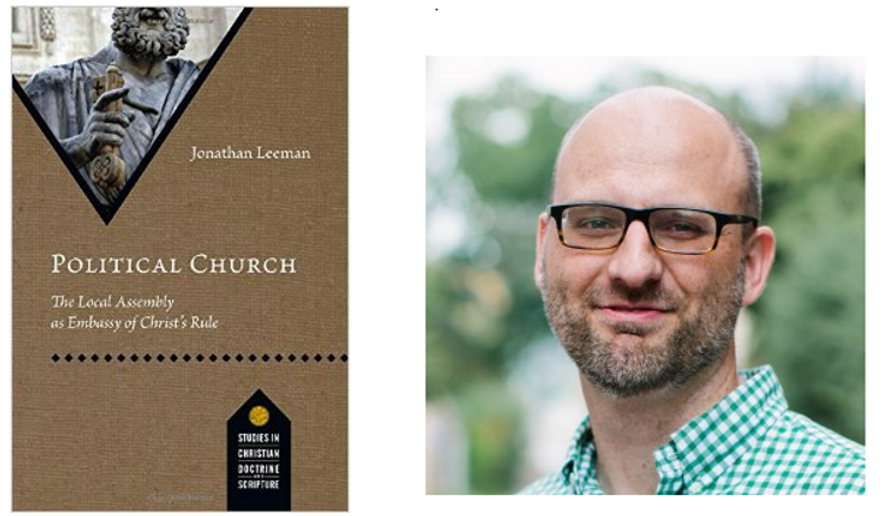
Such is the case with a new book by Jonathan Leeman titled, “Political Church: The Local Assembly as Embassy of Christ’s Rule” (InterVarsity Press, 2016).
Leeman, a pastor at Capitol Hill Baptist Church in Washington D.C., works for 400 pages, opening with an explanation and critique of political liberalism (in the philosophical sense of the word, not the “left vs. right” sense). But the meat of the book is his development of a biblical theology of politics. That is to say, Leeman explains “politics” according to what the Bible says — from Genesis to Revelation.
Like I said, this isn’t fast-food reading. You can’t eat it quick, but it will leave you feeling nourished.
Here’s an excerpt from Leeman’s opening preface:
This book has two main goals. The first is to replace the map of politics and religion that many Christians have been using since the democratic revolutions of the eighteenth century with a more biblical one. The second is to explain where the local church fits onto this redrawn map as a political institution or embassy of Christ’s rule.
…Generally, we think of the public square as the place for politics, while the private domiciles of home and church are reserved for religion, even if we maintain that the boundary between them is porous.
This is the map I want to help throw out. Church and state are separate institutions with different jurisdictions. Neither should confuse itself for the other. One bears the sword, while the other bears the keys of the kingdom. Yet the work of each is set on a landscape where politics and religion are wholly coterminous, like two circle lenses placed perfectly on top of one another. The public square is nothing more or less than a battleground of gods. And the church is a political institution inhabited by citizens of heaven who bear a distinctly political message: Jesus is king.
The division between politics and religion, I dare say, is an ideological ploy. …[T]he public square is inevitably slanted toward the secularist and materialist. Public conversation is ideologically rigged. The secularist can bring his or her god. I cannot bring mine because his name starts with a capital letter and I didn’t make him up.
Meanwhile, churches err in one of two directions. Either they falsely claim to be spiritual, not political, and so fail to take the stands that they should. The Church of England in South Africa’s refusal to address the matter of apartheid is one such example. Or they convince themselves that political advocacy in the public square is their most important work and distract themselves from their primary mission: being the church.
Others have said it before me, but the church’s most powerful political activity is being the church and proclaiming its unique message. …The church wields the keys of the kingdom in order to speak for heaven on earth by affirming the what and the who of the gospel. And the church’s life is held together by justification by faith alone, the most powerful political force in the world today for flattening hierarchies and uniting one-time enemies.
To put it another way, the state is an earthly platform builder while the church is a heavenly signmaker. The state’s work is to build a platform of peace and order and protection for God’s people so that churches can get on with their business. And the church’s business is to hang signs with Jesus’ name over right beliefs, right practices, and right people—the repenting and believing citizens of Christ’s kingdom. Through baptism and the Lord’s Supper, a church hangs signs on God’s people that say, “Jesus Representative.” That is surely not the work of the state, just as employing coercive force for the sake of peace is surely not the work of the church
For Christians who want to think deeper and more biblically about the nature of the church and its relationship to politics and government, “Political Church” will reward you.

Please read our comment policy before commenting.