


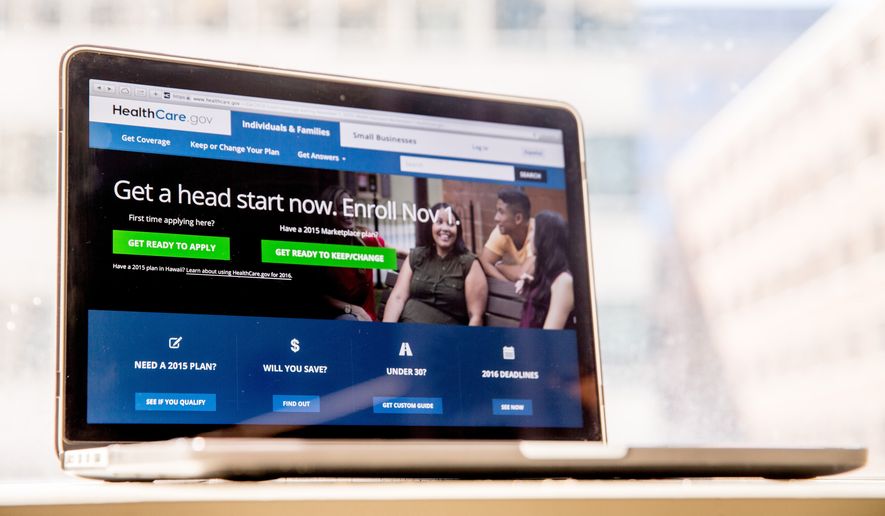

Obamacare’s premiums will likely spike over the next year as health insurance companies grow more pessimistic about the law, the administration acknowledged Wednesday, but officials insisted consumers won’t be stuck with the entire bill.
Even if rates rise 25 percent, most of those who buy insurance plans on the federal HealthCare.gov website will be able to shop for less-costly plans and, thanks to assistance from taxpayer subsidies, will be able to pay much less than the sticker price.
“Headline rate increases do not reflect what consumers actually pay,” said Kathryn Martin, acting assistant secretary for planning and evaluation at the Health and Human Services Department. “Our study shows that, even in a scenario where all plans saw double-digit rate increases, the vast majority of consumers would continue to have affordable options.”
The administration hopes to reassure consumers after most of the cooperative plans under the Affordable Care Act have collapsed and major insurers have announced that they are withdrawing from market exchanges in a number of states.
States are still finalizing rates ahead of the Affordable Care Act’s fourth round of enrollments, which is set to begin Nov. 1, but the early signs are gloomy.
Tennessee has approved an average increase of 62 percent for its largest insurer, Blue Cross Blue Shield, and Mississippi’s insurance commissioner said he has accepted an average increase of 43 percent after “intense and strident negotiations” with Humana.
Illinois on Wednesday released rates that showed an average spike of 43 percent among the silver tier, the second-lowest-cost benchmark plan used to calculate subsidies.
“The health insurance premium increases announced by the Illinois Department of Insurance reaffirm what the people of Illinois already know: Obamacare is a failure,” said Rep. Peter J. Roskam, Illinois Republican.
HHS argues the rate hikes in some cases amount to “one-time adjustments” by insurers who underpriced their plans in the early years after overestimating the number of healthy customers.
Instead, those taking advantage of Obamacare’s exchanges have been older and sicker than predicted, skewing the economics and leading to losses for the insurers.
Companies also are bracing for the expiration this year of a program known as reinsurance that has mitigated the impact of high-cost enrollees.
Analysts say the exchanges’ problems run deep and Congress may need to step in to stabilize the marketplace over the next couple of years.
“One of the issues cited by the national carriers pulling out of the market was their inability to project this market going forward due to the high levels of churn and inherent volatility,” said Caroline Pearson, senior vice president for policy and strategy at Avalere Health, a Washington consulting firm. “As such, we wouldn’t project that the pricing issues or, better stated, the inability to accurately price this market, will be completely solved after 2017.”
For now, HHS is urging consumers to shop around for savings this fall. More than 40 percent of returning customers switched plans for the current year and saved an average of $42 per month.
Yet consumers’ choices are dwindling for next year as UnitedHealth Group, Human and Aetna retreat from a number of markets, citing heavy financial losses.
Unless other insurers step in, consumers in seven states will be left with only one choice, according to Avalere.
“If there is only one health plan offering products in your rating region, you can’t ’shop around’ and will have to simply take whatever premium increases that health plan is offering for the upcoming year,” Ms. Pearson said.
The administration said most customers will still collect subsidies. Some 9.4 million of the exchanges’ 11.1 million customers received tax credits to pay for coverage as of March.
Even if premiums rise by 25 percent across the board, 78 percent of customers can find coverage for $100 or less, HHS said.
The agency acknowledged that its hypothetical is unrealistic because premiums will rise at varying levels across plans and geographic areas, yet it wanted to signal “that even if premium increases for 2017 are significant, the structure of the tax credits will help keep premiums affordable.”
Obamacare’s Republican critics say the model isn’t sustainable and that Congress should start over with reforms that rely on market incentives instead of a complex web of government subsidies, coverage requirements and mandates.
HHS points to congressional budget scorekeepers, who say Obamacare’s coverage provisions are priced lower than projected in part because of a slowdown in health care costs.
Yet the Congressional Budget Office in March said the government saved money because the exchanges were less popular than expected so fewer people took subsidies.
• Tom Howell Jr. can be reached at thowell@washingtontimes.com.

Please read our comment policy before commenting.