The Chauchat, named after its main contributor Colonel Louis Chauchat, was the standard machine rifle or light machine gun of the French Army during World War I (191418). Beginning in June 1916, it was placed into regular service with French infantry, where the troops called it the FM Chauchat. The Chauchat machine rifle in 8mm Lebel was also extensively used in 191718 by the American Expeditionary Forces (A.E.F), where it was officially designated as the "Automatic Rifle, Model 1915 (Chauchat)". A total of 262,000 Chauchat machine rifles were manufactured between December 1915 and November 1918, including 244,000 chambered for the 8mm Lebel service cartridge, making it the most widely manufactured automatic weapon of World War I. The armies of eight other nations Belgium, Finland, Greece, Italy, Poland, Romania, Russia, and Serbia also used the Chauchat machine rifle in fairly large numbers during and after World War I. The Chauchat machine rifle was one of the first light, automatic rifle-caliber weapons designed to be carried and fired by a single operator and an assistant, without a heavy tripod or a team of gunners. It set a precedent for several subsequent 20th-century firearm projects, being a portable, yet full-power automatic weapon built inexpensively and in very large numbers. The Chauchat combined a pistol grip, an in-line stock, a detachable magazine, and a selective fire capability in a compact package of manageable weight (20 pounds) for a single soldier. Furthermore, it could be routinely fired from the hip and while walking (marching fire). The muddy trenches of northern France exposed a number of weaknesses in the Chauchat's design. Construction had been simplified to facilitate mass production, resulting in low quality of many metal parts. The magazines in particular were the cause of about 75% of the stoppages or cessations of fire; they were made of thin metal and open on one side, allowing for the entry of mud and dust. The weapon
Featured Photo Galleries

Military parade celebrates Army’s 250th
Cheers and chants rang out Saturday from a crowd of thousands as soldiers manned modern and historic tanks and aircraft for the Army’s 250th anniversary celebration in the District.


Ovi scores goal 890, Caps lose to Sabres 8-5
Alexander Ovechkin scored goal number 890, but the Washington Capitals fell short, losing to the visiting Buffalo Sabres Sunday afternoon 8-5 at Capital One Arena in Washington D.C., March 30, 2025 (Photos for the Washington Times.)
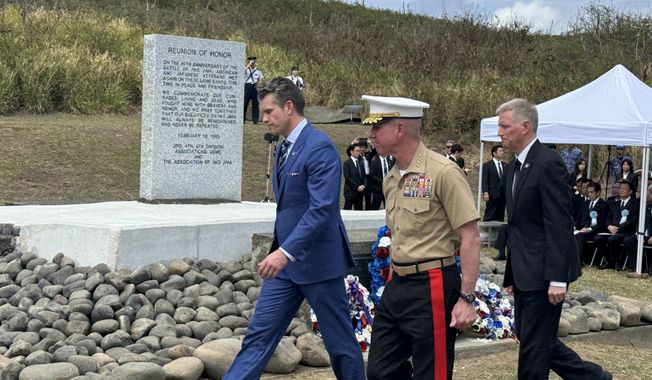
Hegseth joins veterans, generals to mark 80th anniversary of battle of Iwo Jima
A handful of retired Marines – all in the late 90s or over 100 — joined Defense Secretary Pete Hegseth and Japan’s Prime Minister Takeru Ishida on Saturday to mark the anniversary of one of the bloodiest battles of World War II in the Pacific that ended 80 years ago this week.