M1 GARAND - a semi-automatic rifle chambered for the .30-06 Springfield rifle cartridge. It was the first standard-issue semi-automatic rifle. Called 'the greatest battle implement ever devised' by General George S. Patton, the Garand officially replaced the bolt-action M1903 Springfield as the standard service rifle of the United States Armed Forces in 1936 and was subsequently replaced by the selective fire M14, starting in 1957. During World War II, the M1 gave U.S. forces a distinct advantage in firefights against their Axis enemies, as their standard-issue rifles were more effective than the Axis' slower-firing bolt-action rifles. The M1 continued to be used in large numbers until 1963 and to a lesser degree until 1976. Like its predecessor, the M1 originated from the Springfield Armory. Today, the M1 remains in use for drill purposes. The M1 is an air-cooled, gas-operated, clip-fed, semi-automatic, shoulder-fired weapon. This means that the air cools the barrel; that the power to cock the rifle and chamber the succeeding round comes from the expanding gas of the round fired previously; that it is loaded by inserting an en-bloc metal clip (containing eight rounds) into the receiver; and that the rifle fires one round each time the trigger is pulled. After the eight rounds have been shot, the empty clip automatically ejects with an audible "ping" noise. The M1 was the standard-issue service rifle of the U.S. forces in World War II, the Korean War, and also saw service to a limited extent in the Vietnam War. Most M1 rifles were issued to U.S. forces, though many thousands were also lent or provided as foreign aid to America's allies. Library of Congress photo.
Featured Photo Galleries

Military parade celebrates Army’s 250th
Cheers and chants rang out Saturday from a crowd of thousands as soldiers manned modern and historic tanks and aircraft for the Army’s 250th anniversary celebration in the District.


Ovi scores goal 890, Caps lose to Sabres 8-5
Alexander Ovechkin scored goal number 890, but the Washington Capitals fell short, losing to the visiting Buffalo Sabres Sunday afternoon 8-5 at Capital One Arena in Washington D.C., March 30, 2025 (Photos for the Washington Times.)
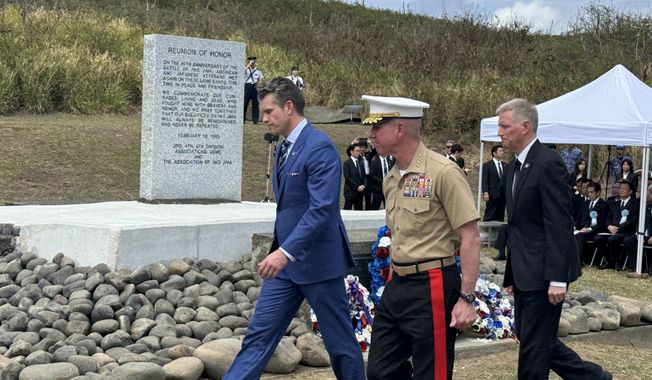
Hegseth joins veterans, generals to mark 80th anniversary of battle of Iwo Jima
A handful of retired Marines – all in the late 90s or over 100 — joined Defense Secretary Pete Hegseth and Japan’s Prime Minister Takeru Ishida on Saturday to mark the anniversary of one of the bloodiest battles of World War II in the Pacific that ended 80 years ago this week.