


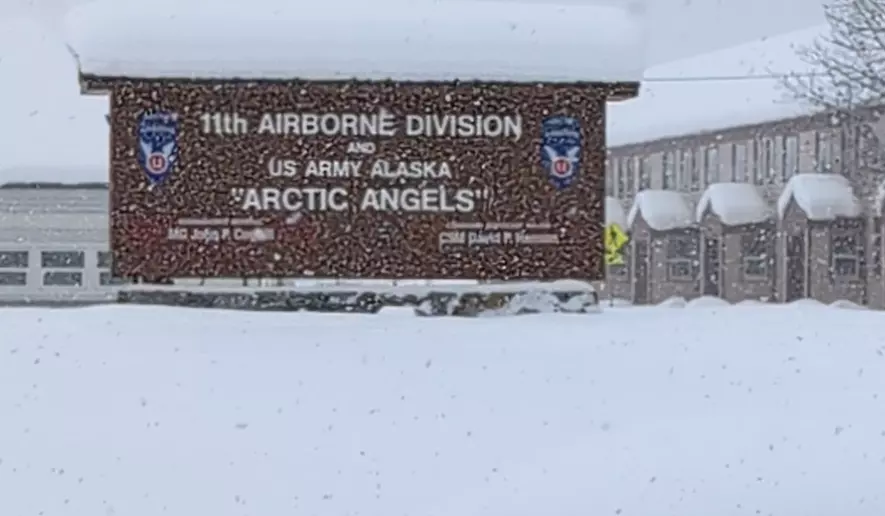

Arctic Notebook, Feb. 18: Washington Times Defense and National Security Correspondent John T. Seward is on assignment in frigid northern Alaska, covering the U.S. Army’s “premier Arctic training exercise.” As tensions rise in the frozen north, Mr. Seward’s reporter’s notebook dispatches go inside his experience observing the American military’s preparation for combat in the sub-zero temperatures.
FAIRBANKS — I rode in a full cabin of assorted businessmen, tourists, heavy equipment operators and military personnel — all traveling to a destination almost 150 miles south of the Arctic Circle.
As our flight took off just a few minutes before midnight, the temperature outside at the Seattle-Tacoma International Airport was 36° Fahrenheit. It was 11° and snowing as we stepped off the plane in Fairbanks at 3:00 a.m.
I’d already been warned that multiple soldiers were removed from the training event I was heading to due to frostbite. Overnight temperatures were flipping the gauge, with temperatures dropping down to -35°. What I wasn’t expecting was how dry it was. Even the snow. A winter storm warning was in effect and snow totals were climbing, but the snow was a very fine, dry powder.
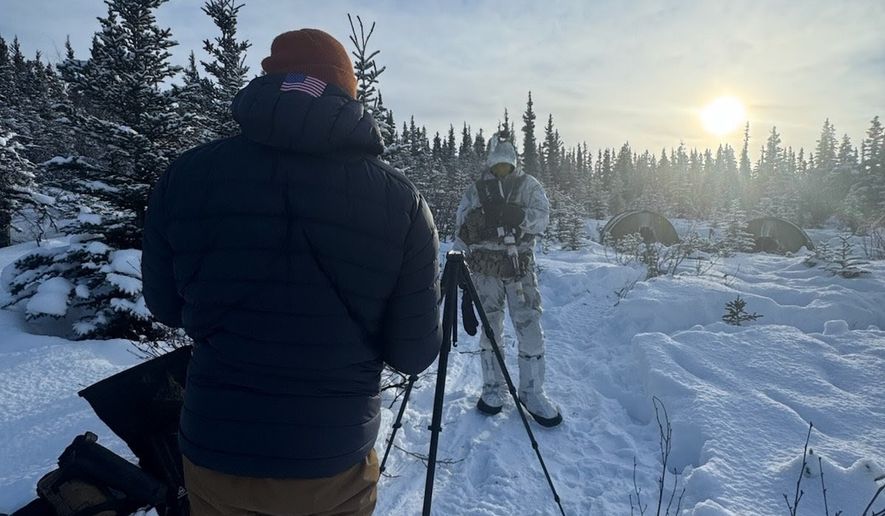
After picking up a rental car, my troublesome logistics day driving around in near white-out conditions began, turning into a repetitive practice in steering atop ice and slippery hard pack snow. It eventually got down to single-digit temperatures later in the day and surprisingly, conditions improved.
I was able to rent heavier boots and an expedition parka in anticipation of the even colder temperatures. I’m set to connect with the 10th Special Forces Group Thursday morning, and without the parka and boots, I’d be risking my fingers and toes as I engage with them out in the training area.
On my way to secure this life-protecting equipment, I slightly miscalculated a wide turn and immediately got stuck. Despite the reassurances of the rental car employee, this 2-wheel drive sedan was not up to the challenge. A helpful Fairbanks business owner — a former police officer — helped pull the car out of the drift and send me on my way, late for my next engagement.
It reminds me of something writer and Arctic explorer Neil Shea told me in an interview leading up to this trip. Everything in the Arctic just takes longer. You have to get used to that.
I’m able to finish the day without getting stuck again. After some time spent discussing tomorrow’s plans with my military colleagues, I leave for a private event at the University of Alaska Fairbanks’ Museum of the North.
It’s attended by both Republican senators from Alaska, Lisa Murkowski and Dan Sullivan. The Army is also at the event, in force — including U.S. Army Chief of Staff Gen. Randy George and Gen. Ronald Clark, commander of the U.S. Army Pacific.
They’re all here to discuss and learn about research being done in the Arctic on drones, counter-drones, remote sensing, and Arctic policy.
Twenty hours after landing in Fairbanks, Alaska, I leave to prepare for Thursday’s time with 10th Special Forces. I’ve been told we’re going to be inserting via snowmobile.
As I close out for the evening, it’s 2° outside.
This is the first installment of a four-part Threat Status series, “Arctic Notebook.”
Click here to receive the daily Threat Status newsletter delivered directly to your inbox.

• John T. Seward can be reached at jseward@washingtontimes.com.

Please read our comment policy before commenting.